Air Travel to Double by 2050: What It Means for You
Klaus Schmidt ·
Listen to this article~5 min

IATA projects global air passenger demand will more than double by 2050, with mid-range forecasts showing 20.8 trillion revenue passenger kilometers. This growth signals massive changes for airports, airlines, and travelers worldwide.
So, I was looking at this new report from the International Air Transport Association, or IATA as they're known in the industry. They dropped some pretty eye-opening numbers about where air travel is headed. Honestly, it's one of those forecasts that makes you pause and think about how much our world is changing.
They released their Long-Term Demand Projections on March 17, 2026, and the headline is simple but massive: global air passenger demand is expected to more than double by 2050. That's not just a small bump—we're talking about completely transforming how people and goods move around our planet.
### Understanding the Numbers Behind the Growth
Let's break down what "more than double" actually means in practical terms. The report gives us three different scenarios, which is smart because the future is never just one straight line.
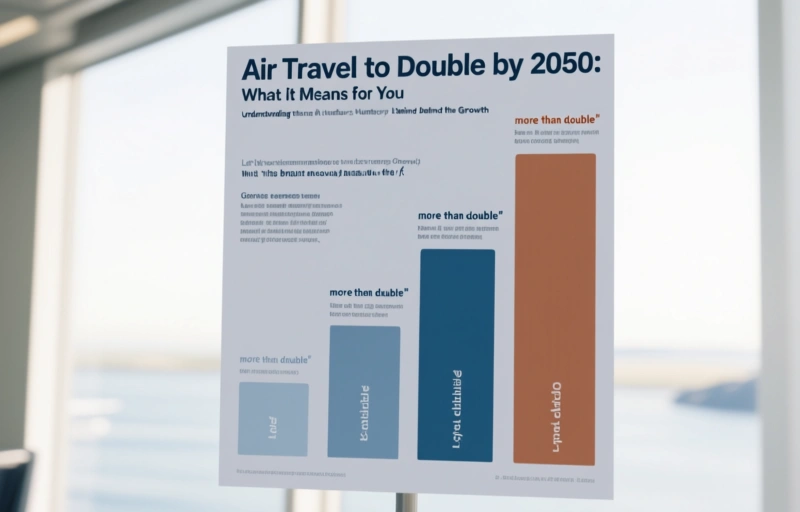
- In their middle-of-the-road scenario, demand hits 20.8 trillion revenue passenger kilometers by 2050. That's up from 9 trillion back in 2024. They're calculating a 3.1% compound annual growth rate to get there.
- If things really take off (pun intended), we could see a higher growth scenario with 3.3% annual growth, pushing demand to 21.9 trillion RPKs.
- Even in a slower growth world, we're still looking at 2.9% annual growth and 19.5 trillion RPKs.
Now, I know what you're thinking—trillions of anything is hard to wrap your head around. Think of it this way: if you lined up all those passenger kilometers, you'd be making trips to the moon and back... millions of times over. The scale is almost incomprehensible.
### What's Driving This Massive Expansion?
We should talk about why this is happening. It's not just one thing—it's several trends converging all at once.
First, there's population growth and urbanization. More people living in cities means more connections between those cities. Then there's the rising middle class in developing economies. When people have more disposable income, travel often becomes a priority—whether for business, visiting family, or exploring new places.
Technology plays a huge role too. Aircraft are becoming more efficient, which helps bring costs down. And digital platforms make booking travel easier than ever. You can plan an entire trip from your phone while waiting for coffee.
As one industry analyst recently noted, "We're not just predicting more flights—we're predicting a fundamental shift in how humanity connects. The airplane is becoming what the railroad was in the 19th century: the great connector of people and economies."
### The Ripple Effects You'll Feel
This growth isn't going to happen in a vacuum. It's going to touch everything from your local airport to the price you pay for tickets.
Airports will need to expand. We're talking about more terminals, more runways, and way more infrastructure to handle all those additional passengers. If you've ever been stuck in a crowded terminal, imagine that scenario becoming much more common unless we plan ahead.
Airlines will need to buy hundreds of new aircraft. That means billions of dollars in investments, which will ripple through manufacturing and supply chains. It also means more jobs—pilots, flight attendants, mechanics, ground crew.
For travelers, there are both upsides and challenges. More competition could mean better prices and more route options. But it also means crowded skies and potential delays unless air traffic control systems get major upgrades.
### The Environmental Question We Can't Ignore
Let's be real—this much growth brings serious environmental questions. Aviation currently accounts for about 2-3% of global CO2 emissions. If we double the number of flights, we need to seriously address the sustainability question.
The industry is working on sustainable aviation fuels, more efficient aircraft designs, and operational improvements. But there's still a long way to go. This growth projection makes finding solutions not just nice-to-have, but absolutely essential.
### What This Means for Your Business
If you're in any business connected to travel, tourism, or global trade, these numbers should be on your radar. More air travel means more opportunities, but also more complexity.
Supply chains will need to adapt. Logistics companies will need to plan for increased cargo capacity. Hospitality businesses near airports should think about expansion. And anyone in the travel tech space has a massive market growing right in front of them.
The bottom line? We're heading toward a world where flying becomes even more woven into the fabric of how we live and do business. The question isn't whether this growth will happen—the IATA projections make that pretty clear. The question is how we'll manage it smartly, sustainably, and in ways that benefit everyone who wants to explore our connected world.
It's going to be quite a journey.